Culture Club (AHK) Kattenburgerstraat 5, Amsterdam
Workshopday ‘Data in the Arts’
past:
Kanaal30, Utrecht
DIS_SEMINAR #3
BAK Basecamp, Utrecht
What Methods Do symposium 2026
Maastricht (specific location tbd)
Workshop on Ethics in Art Research – 2!
Willem de Kooning Academie, Rotterdam
Workshop Ethics in Artistic Research
HKU (Nieuwekade 1, Utrecht)
CWI Discussion & Debate
LocHal, Tilburg
PD Arts + Creative Symposium: The Resonance of PD Research
Fontys, Tilburg
Publication event Performance Research
Cursus- en vergadercentrum Domstad, Utrecht
Shaping the Future of Data Management in Artistic Research
BUas Breda University of Applied Sciences
3rd Symposium of the PD Programme Arts + Creative
Textielmuseum Tilburg
What Methods Do – International symposium
Conservatorium van Amsterdam
Symposium ‘A Tower of Babel: Institutions and Epistemologies’
Articulate Research Festival, Antwerpen
launch FORUM+ dossier “The art school as an ecosystem”
Orangerie in the Amstelpark
Polyphonic Landscapes – 2nd seminar
HKU, Ina Boudier-Bakkerlaan 50, 3582 VA Utrecht
Professional Doctorate Programme – Arts + Creative 2nd symposium
Royal Conservatoire, Amare, The Hague
Symposium ProMiMiC
Social Impact Factory, Utrecht
Training Research Integrity (by NRIN)
Online opening seminar
Polyphonic Landscapes (by ArtEZ + Zone2Source)
hybrid: Rotterdam, Kruisplein (Lokaal 6.41) and via livestream
Codarts Research Festival
Fontys University of the Arts Tilburg
Connective Symposium
Fontys School of Fine and Performing Arts Tilburg
Inaugural Lecture: In good Company. Think we must.
Fort de Batterijen, Nieuwegein
DIS_SEMINAR #2
Sweelinckzaal, Conservatorium van Amsterdam
Mini-Symposium: The societal relevance of improvisation in dance and music + panel discussion on artistic doctorates
UvA Aula (ingang Singel 411), Amsterdam
Disquieting Histories: Notes on Silence in the Graphic Design Archive – inaugural lecture Alice Twemlow
Gerrit Rietveld Academie, Amsterdam
Hanging On: Artistic Research in, on and for the Public Domain
Gerrit Rietveld Academie, Amsterdam
Out of Place: Inaugural Lecture by Patricia de Vries
HKU X, Ina Boudier-Bakkerlaan 50, 3582 VA Utrecht
Platform meeting autumn 22
Maastricht, Jan van Eyck Academy
MERIAN Launch event
online (host: kunst ≈ onderzoek)
Work of Research – collaborative session (cancelled)
AHK Reinwardt Academie, Hortusplantsoen 2 Amsterdam
kick off UAS Professional Doctorate Kunst + Creatief
St. Joost School of Art & Design, 's‑Hertogenbosch
Co-creating the curriculum for the PD Kunst + Creatief
De Kadeboot at cultural free port De Nijverheid in Utrecht
hello/goodbye netwerkborrel
Zuyd, Maastricht
Writing retreat – ‘‘How others Write’
IJver, Amsterdam
Creator Doctus final conference
Academy of Fine Arts, Vienna
ELIA – closing event Supervising Artistic Doctorates (Erasmus+)
online (host: kunst ≈ onderzoek)
3rd cycle models in EU – expertmeeting
online (host: kunst ≈ onderzoek)
Programma: exploring ethical issues in research in the arts
online (host MERIAN / Hogeschool Zuyd and Universiteit Maastricht)
MCICM symposium ‘Towards 2040: Creating Classical Music Futures
Rietveld livestream
Public defence Yael Davids – Creator Doctus
Wits University, Johannesburg, South-Africa
Art Research Africa (ARA) Conference
DAS Graduate School, Amsterdam
THIRD Annual Forum 3rd cycle research
Royal Academy of Art The Hague
FAULT LINES: research symposium and exhibition 2019
Conference at Centre Pompidou, Paris
Creator Doctus conference
Erasmus University Rotterdam and De Kunsthal
RASL event: Transdisciplinary Compositions | Contemporary Challenges.
Tolhuistuin, Amsterdam Noord
DIS_SEMINAR exposium art ≈ research
Welcome to guests/participants
Registration for DIS_SEMINAR #3 is open now
announcement by JUST ART. Creating Common Grounds for Climate Justice Through Artistic Research
JUST ART offers 10 new PhD positions
JUST ART. Creating Common Grounds for Climate Justice Through Artistic Research is a six-year project on climate justice and artistic research in the Caribbean and European parts of the Kingdom of The Netherlands. The project is funded by the Dutch Research Council (NWO) and coordinated by the University of Groningen.
The project is currently offering 10 PhD positions at six universities in collaboration with the Netherlands Organisation for Applied Scientific Research (TNO) and four universities of applied sciences.
JUST ART PhD candidates will generate new knowledge and critically assess approaches that integrate scientific insights with artistic research to address climate justice. They will study and develop concrete cases to learn how art and artistic research can be embedded in ongoing and emerging work on climate justice.
The candidates will enhance expertise and skills to take artistic and art-based transformative action on climate justice and will contribute to theoretical frameworks, common methods, educational toolkits and knowledge sharing platforms in co-creation with project partners.
Detailed descriptions of the individual PhD projects and application links for each partner university can be found on the project website: https://justart.info/phd/
16 January 2026
Working Day on Ethics: report
On 16 January 2026, platform art ≈ research, the Willem de Kooning Academy and the Scientific Integrity Committee for the KUO organized a joint working day on the theme of ethics. We met at HKU to work together on the poster/zine about ethical issues and to reflect on the new NGWI code. There were about twenty participants, consisting of PhD-candidates and researchers, committee members of the CWI and research support staff.
In the morning program, Miriam Rasch and Florian Cramer took us through their third and final workshop on ethical issues in artistic research.
Last year, platform art ≈ research published an open call among our members on the theme of ethics. In response, Miriam Rasch, Florian Cramer and Harma Staal from the Willem de Kooning Academy organized a three-part workshop on ethical issues in artistic art education and -research in 2025/2026. In the first workshop (spring 2025), we discussed (un)ethical attitudes and behaviors. The second workshop (autumn 2025) focused on (un)ethical topics.
In this third workshop, we examined the results of the first two workshops. In preparation, Florian and Miriam had summarized these results in a draft to be used as a starting point for a poster, that can be folded into a zine. In groups, we reflected on this edit in terms of wording, topics and recommendations. Topics such as working with others, ambiguity, failure, cultural appropriation and activism were discussed. We also reflected on the rapid developments within ethics as a theme: it may well be that our conclusions will be outdated in a few years’ time, which underlines the importance of an ongoing dialogue.
In the afternoon, the KUO-CWI (the complaints committee for the seven mono-sectoral art academies) worked with participants on the code of conduct for integrity. Following the 2018 code of conduct, a new code of conduct will be introduced in the spring of 2026. This code of conduct is endorsed and will be implemented by all art academies. The KUO is responding to the current draft, partly through this meeting. How does the code relate to art research and art education? How will it be implemented?
In groups, we discussed the code itself, but also who had encountered it before and in what way and situations where the code applies to our (daily) work. We then zoomed in on the five principles highlighted in the code (fair, careful, transparent, responsible) and what issues arose for us when we linked these principles to the realities and challenges of artistic research.
For example, how are these principles implemented in consortia and collaborations with external partners – what if they do not endorse this code, or endorse it to a lesser extent? How do we jointly determine what is complied with and how can we make the code tangible and relevant in the heat of the moment?
The minutes of the meeting will be compiled and submitted by the KUO-CWI to the NGWI, so that the feedback can be incorporated into the final version. The poster/zine of the Willem de Kooning Academy is expected to be published in the spring of 2026.
Peer-to-peer support structure for practice research in the arts 'THIRD' (AHK Academy of Theatre and Dance) is looking for proposals!
THIRD: Call for proposals
- 27 January 9.30-10.30hrs CET time.
- 19 February 16.00-17.00hrs CET time.
Video about data management in artistic research
What’s the deal with data (in the arts)?
Platform Kunst ≈ Onderzoek, in collaboration with the Data in the Arts knowledge group (HKU, AHK, and ArtEZ), presents a short informative animation about data management in artistic research. This English-language video addresses questions that researchers have about the theme of “data” and how it applies to art research, highlighting the complexity that can arise. There are more questions than answers, but together we are learning and professionalizing more and more.
Animation by Mud Motion
Script by Iris Spanbroek
Featuring images of “The Aesthetics of Touch” by Marloeke van der Vlugt
New zine based on the "Ethics in the Minor Key" workshop!
Ethics in the Minor Key
Last February, the workshop “Ethics in the Minor Key” took place, organised between AHK, HA, GRA, TU Eindhoven, Fonts, CARADT / Avans, and UvA.
Lead by Gabriele Ferri and Laura Cull Ó Maoilearca, the workshop focused on ethical frameworks and its complexities.
The result of the workshop is a zine, a pdf of which you can view below!
Key Enabling Methodologies: de sleutel tot verandering
KEM-session at the SIA congress
During the SIA-congres 2024 “The compass of practice-based research” on November 28, some art professors the session: “Key Enabling Methodologies: de sleutel tot verandering”.

This session will be a dive into the topic of Key Enabling Methodologies (KEMs). KEMs offer professionals a targeted approach to the development of innovations and interventions that contribute to solving societal challenges. How do you use these methods in practice-based research? The application of KEMs is anything but simple and requires extensive knowledge, experience and good cooperation between different disciplines. In a panel discussion with experts, we analyze examples, explore opportunities and challenges, and open the way to new ways to collaborate.
Speaker(s)
Laura Cull Ó Maoilearca (moderator) (DAS graduate school)
Caroline Hummels (TU / Eindhoven)
Fabiola Camuti (HKU)
Josien Pieterse (Framer Framed, Amsterdam)
website launched
Committee for Scientific Integrity of Universities of the Arts online
Universities of applied science are responsible for higher vocational education, and also increasingly acting as knowledge institutions. The practice-based research that is conducted at these institutions, must comply with high quality standards. Therefore, the Netherlands Association of Universities of Applied Sciences adopted the policy to implement the Netherlands Code of Conduct for Research Integrity (NGWI, October 2018) at all Universities of Applied Science.
The seven monosectoral universities of the arts also adhere to the norms of this code of Conduct. Amsterdam University of the Arts, ArtEZ, Codarts, Design Academy Eindhoven, HKDH, HKU and Rietveld Academie established a collective Committee for Scientific Integrity (CWI-KUO) for the arts education per 1 January 2023. This committee has the task to process any complaints concerning integrity. The cooperation between the seven universities of the arts ensures that the expertise in practice-based research in the arts is properly and broadly represented.
More information on the committee, the assignment, way of working and members can now be found online:
Come and join our research community event on November 29
Registration DIS_SEMINAR #2 is open now!
After a successful first DIS_SEMINAR in 2019, the platform will organise a second edition in 2022. This will include space for alternative forms of sharing artistic and design research, and attention to ethical issues. If you’re a professor, lecturer/researcher, postdoc or third cycle researcher or a curious student, feel welcome to join. The program will consist out of presentations and interactive working session by different professorships in art & design.
Admission is free of charge, but registration is required.
Soon we’ll publish the full programme.
Registration is open now: please fill in the form here.
contribute to the exposium
DIS_SEMINAR #2 – call for proposals
On Tuesday 29 November 2022 from 10.00 to 18.00, the platform kunst ≈ onderzoek (‘art = research’) will again organise a exposium. The location for this edition is Fort De Batterijen in Nieuwegein, close to Utrecht.
The name of this year’s edition remains the same as in 2019: DIS_SEMINAR as we prolong the theme of alternative forms of dissemination of research in the arts. We regard the event as an informal setting to present research in the arts to each other, discuss and exchange them, and together contribute to the discourse of artistic research in the Netherlands. The programme is set up as such that it’s for the professorships, by the professorships. Therefore we hope we can count on your participation!
call for proposals
The programme consists of several keynote speakers and smaller work sessions. It will be held in English. The contents of the sessions are linked to the works of art and design lectorates. We invite you and other researchers in your professorship to contribute as:
- Presenting professorship (in collaboration with artists-researchers)
- Discussion leader / moderator, who also introduces a question or statement
- Ref-Lector, for a written reflection and summary of the session
We expect to have multiple alternating sub-sessions. The general overview looks like:
- Presentations: short alternative presentation forms of art research, such as, for example, a performance lecture, exposition, interactive installation. These can also be disseminations of or postdoc research, third cycle or MA research! Estimated duration: 20 minutes
- Discussion: following up on the presentation, a discussion leader introduces a question or statement with regard to the dissemination form. This starts a discussion/conversation or workshop under guidance of the discussion leader. The main questions or statements are collected at the end and fed back. (45-60 minutes)
- Reflection: each sub-session ends with one researcher who summarises the focus points of the conversation at the end of the exposium, along with a short reflection for on the website.
Productional and financial conditions for presentations
A compensation fee is available for the presentations; for any incurred costs and for the presenting artist-researcher (practice-based researcher). We like to hear about any technical and financial conditions you have. Complex projects that require lots of set-up time or technical support are difficult to realise. Please take this into account. We can make use of the full Fort location, including the outdoor area. You can see the different spaces here: https://fortdebatterijen.nl/.
If you have a preference for a specific area, please indicate this when you register your proposal.
Proposals for participation (before 18 October 2022)
Interested in showing yourself and contributing to the programme? In the enclosed document you can indicate how you want to participate. You can also suggest someone else from your research group or network to present/moderate or reflect. In case of multiple registrations, we will have to make a selection. Send your registration to kunstenonderzoek@gmail.com before October 18. Please use this form.
When you are not able to actively contribute, we still hope to receive you and the researchers from your professorships & institutions as visitors on 29 November, as well as post-docs, (pre-)PhD students, research assistants and policy officers. The invitations will be available to share further soon.
If you have any questions, do not hesitate to contact us. We like to think along. Let’s co-create a fabulous and exciting programme together again!
job position - deadline for applications October 1, 2022
MERIAN PhD candidate in Maastricht style artistic research
The Maastricht Experimental Research In and through the Arts Network (MERIAN) invites artists and academics to engage in collaborative research in between making and thinking.
As a MERIAN PhD candidate you mobilize the powers and fragilities of artistic and scientific practices to engage in research that is problem-based and methodologically innovative, and which focusses on interdisciplinary topics that can fruitfully be explored across the arts and academia.
More information: https://www.academictransfer.com/en/316412/merian-phd-candidate-in-maastricht-style-artistic-research/
News from the NWA Art route
Michel van Dartel is the new figurehead
Janneke Wesseling will soon retire and has therefore recently resigned from her duties as figurehead of the Art route. She proposed Michel van Dartel as her successor, a proposal that was wholeheartedly supported by the steering committee of the Art route. Van Dartel is director of the platform for art and media technology V2_Lab in Rotterdam and lector at Avans Center for Art Design and Technology.
Van Dartel supports the goals of the NWA (De Nationale Wetenschapsagenda) and the mission of the Art route as formulated under the chairmanship of Wesseling. “The confidence that the route instills in me is an enormous stimulus, also for the work that I do as a director and lector,” says Van Dartel.
In this article he introduces himself.
ArtEZ Platform for Research Interventions of the Arts (APRIA)
New issue of APRIA Journal, Urgent Publishing
Announcing the new issue of APRIA Journal, Urgent Publishing, edited by Miriam Rasch and Nishant Shah, with contributions by Florian Cramer, Labor Neunzehn, Miriam Rasch and Paul Soulellis.
Urgent Publishing delves into the question of how publishers can keep up standards of quality and care for their audiences in a sphere that is increasingly dominated by breaking news, hype cycles and metrics. How can a different approach to the timeframes or tempo of publishing help in building relevant publics for content? Beyond the commodified practices of publishing one-off objects, how can publishing be a tool for critical community building?
The full issue is now available online and as a downloadable pdf.
To read, visit: apria.artez.nl/issue/urgent-publishing
About APRIA
APRIA (ArtEZ Platform for Research Interventions of the Arts) is a digital platform that curates an open-access, peer-reviewed journal (APRIA journal) and showcases the latest in art research at ArtEZ. APRIA platform also publishes high-impact essays, image and sound contributions that examine art and interventions of the arts in relation to science and society. An annual Open Call encourages students, artists, and researchers affiliated with ArtEZ to submit their own contributions. APRIA is an initiative of ArtEZ University of the Arts, ArtEZ Press and ArtEZ Studium Generale. apria.artez.nl
Invitation to an initiative of the Institute of Cartopology 20-21 August
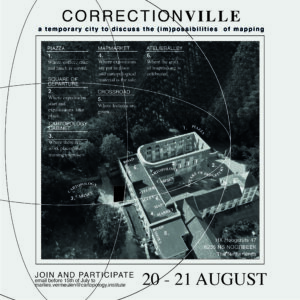
CORRECTIONVILLE #01
You are cordially invited to CORRECTIONVILLE #01 which will focus on the cartopological craft by facilitating workplaces and dealing with documentation and observation techniques through workshops. Lectures will be organized to further explore the theoretical cartopological framework. CORRECTIONVILLE #01 is an initiative of the Institute of Cartopology. As such, it forms a part of Marlies Vermeulen’s PhD research at Zuyd University, Research Centre for Arts, Autonomy and the Public Sphere and of MERIAN. The first edition will take place at HX Hoogcruts 47, Noorbeek (NL). Like any city, CORRECTIONVILLE #01 is growing organically and not every square meter is planned. CORRECTIONVILLE #01 is open to initiatives from other mapmakers to claim a place and experiment! Apply before July 15.
More information www.cartopology.institute
PhD Marlies Vermeulen
ArtEZ Theory in the Arts Professorship
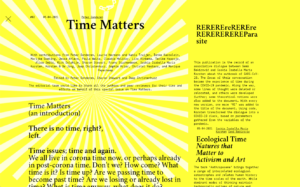
The new APRIA Journal is out: Time Matters.
This issue of APRIA, Time Matters, was compiled and edited by the ArtEZ Theory in the Arts professorship. All of these reviewed artistic (research) and academic contributions were created and written specially in response to the four-part Time Matters seminar (2019-2020). The aim of the publication and the seminar is to inquire into the changing concepts of time in the arts and other epistemic fields collectively, and to explore and test alternative – past, present and future-oriented – temporalities.
Hanze Hogeschool has a
vacancy PhD candidate Art & Society
The Research Centre Art & Society currently has a vacancy for a PhD candidate Art & Society.
Closing date: 24 january 2021. More information and full vacancy can be found here